
Bookkeeping Archives - Page 5 of 7 - First Class Accounts Ovens and Murray and Busy01 Consulting

Category Archives for "Bookkeeping"

Getting your bookkeeping ready for a digital future

Getting your bookkeeping ready for a digital future

Is your bookkeeping ready for a digital future?

Keeping up-to-date records of your business transactions isn't the most glamorous part of being an entrepreneur, that’s for sure. But, in reality, having accurate and up-to-date bookkeeping is actually one of the core ways to keep your finances (and your business) under control.

Digital bookkeeping is the future of your finance

The digital age has revolutionised the way many business owners carry out their bookkeeping. From digital accounting to real-time data, the modern bookkeeper is now equipped with the tools and resources to make the job easier, more efficient and (crucially) less time-consuming.

When your bookkeeping goes digital, that means:

Your data entry process gets automated

Receipts, invoices and other supporting documents can all be scanned using OCR software. This gives you a digital copy of the paperwork, but also digitises the data and pulls it into your online ledgers. There’s no need for tedious manual data entry, and you also reduce the chances of human error.

Your digital records are available 24/7 in the cloud

Instead of searching through messy hard drives or dusty filing cabinets, all your financial documentation is available at the press of a button. You can pull up the documents you need at any time of day, from any location with internet access. And everything is safely encrypted and backed up.

Your tax returns can be filed digitally

With all your bookkeeping data saved and accessed via your cloud bookkeeping/accounting software, your tax returns become a lot more straightforward. Whether it’s quarterly GST/VAT returns or annual corporation tax returns, you have all the data the tax office needs, ready to send in a digital format.

Your finance data goes real-time 

Scanning and digitising your receipts at the time you make the transaction doesn’t just keep your records up to date. It also gives you real-time data on all your income, expenditure and operational costs. Instead of working with management information that’s months out of date, you have informative real-time data on which to base all your big business decisions.

You’re 100% in control of your finances

By embracing the benefits of digital bookkeeping, you kick your finances into shape. You and your finance team have accurate real-time records of all income and outgoings, and can stay in complete control of the financial management of the business. Your accounts are in tip-top shape and you're ready to file your tax returns at every significant period throughout the year.

If you want to transform your bookkeeping, now’s the ideal time to go digital.

Talk to us about getting your bookkeeping ready for a digital future.

Once you see the efficiency, accuracy and long-term benefits of digital bookkeeping, you’ll understand why going digital is a no-brainer, whatever type of business you run.

When to Register Your Business for GST

When to Register Your Business for GST

When to Register Your Business for GST

Should you register your business for GST?

Many business owners register their businesses from day one, regardless of income. Others, for example, many sole traders, choose not to register for GST until it is mandatory.

However, it is common that new businesses don’t realise they have exceeded the income threshold at which they must register! This can result in having to pay GST on sales to the ATO even if you haven’t included it in your prices – so you could lose one-eleventh of your income.

When is GST Registration Compulsory?

Your business must register for GST when it makes $75,000 income within a financial year. If you’re regularly making $6,250 or more each month, it’s time to check whether you should register for GST.

It’s good practice to check your turnover every quarter, and when you are getting close to the threshold, check every month. If you’re not yet using online accounting software, talk to us about your options, as this will make reporting and preparing for GST registration much easier.

You must register for GST within 21 days of reaching the threshold.

Special Rules

  • You can voluntarily register even if your turnover is less than $75,000. This means you can complete an annual BAS if you prefer.
  • If you’re making money through a ride-sharing platform like Uber, you must register for GST immediately. All commercial driving income, regardless of turnover, is subject to GST registration.
  • If you want to claim fuel tax credits, you must register.
  • If your business is a not for profit, the registration threshold is $150,000 per financial year.
  • If you’re not an Australian resident business, the rules for working out GST turnover are different, so talk to us before registering.

Need Help?

When starting a new business, there are many decisions to make, and GST registration is just one of them. Get in contact about the benefits of registering, and we'll help you get set up on appropriate accounting software to help you on your way to business success.

basics of business tax

Basics of Business Tax

Basics of business tax

Different business structures pay taxes in different ways, so it's important to have an understanding of the basics.

Although there are many taxes that a business might be affected by, the main ones are:

  • goods and services tax
  • income tax
  • pay as you go withholding tax for employees
  • payroll tax
  • excise tax

Other taxes that a business could encounter are:

  • fringe benefits
  • capital gains
  • property
  • vehicle
  • other duties and levies administered by state or local governments
Taxes Paid on the Business Activity Statement

Once your business is registered for the relevant taxes, several are reported and paid as part of the monthly or quarterly activity statement.

  • GST is collected from customers and paid to suppliers, and you pay the difference between GST on sales and purchases
  • PAYG Withholding for employees or suppliers that don’t provide an Australian Business Number
  • PAYG Instalments contribute towards an expected income tax bill
  • Other taxes paid on the BAS (if applicable) are fringe benefits instalments, fuel tax credits, wine equalisation tax and luxury car tax
Taxes and Other Fees Paid to State Revenue Offices

Some business taxes are paid directly to the state revenue office, such as land tax for property purchases and payroll tax once the state threshold of reportable wages is reached. Other common government duties include stamp duty on property transfers and land tax.

Income Tax for Businesses

Income tax is calculated after the end of the financial year, taking into account any PAYG instalments already paid.

Tax deductions for business expenses reduce your taxable income and, therefore, your tax bill.

If financial gain is made on the disposal of assets, such as property or shares, capital gains tax is paid on the amount of financial gain and is paid as part of income tax.

Income tax for business is calculated differently according to the type of entity.

Small Business Tax Concessions

Your tax agent can make sure you are claiming all the small business tax benefits that you are allowed through concessions that reduce the amount of tax liability.

For example, there are specific concessions for asset write-off, primary producers, fringe benefits or start-up expenses. Concessions also apply in some situations to reduce the amount of capital gains tax payable.

Thinking of starting or changing your business?

Talk to us about adding or cancelling tax registrations, concessions and planning for the various taxes your business will need to manage.

E-invoicing

E-invoicing

E-invoicing

Is your business using e-invoicing?

It’s a fantastic way to protect yourself and your customers from invoice scams, and it can help you get paid faster. E-invoices replace emailed PDF invoices or links to online invoices. Instead, e-invoices are delivered securely to your clients, even across different accounting systems.

Preventing invoice fraud

Invoice scams are surprisingly common, and can be quite sophisticated.

For example, with intercepted invoices everything looks exactly right, but the bank account number has been altered. When it happens to you, your client thinks they’ve paid you, but the money has actually gone to a scammer. 

Another example is when you receive notifications from suppliers that their bank account number has changed. But it’s not actually your supplier, it’s fake, and your money is going to a scammer.

In the event of an invoice scam, it can be very difficult to get your money back.

E-invoicing prevents these types of scams because the invoices travel directly from one accounting or payment system to another. By directly connecting suppliers with their clients, there’s no opportunity for scammers to intercept the invoices.

Start sending and receiving e-invoices

When you have your accounting software set up for e-invoicing you can send and receive e-invoices immediately.

You can also use e-invoicing if you don’t use an online accounting platform. There are a number of e-invoicing enabled software providers. Talk to us about which one would suit your business.

It only takes a little bit of time to learn how to use e-invoicing.  And once you have implemented e-invoicing you’re more protected from invoice fraud. So, it’s well worth getting it set up!

We can help you set up your accounting software to send and receive e-invoices immediately. Talk to us about how

Keeping your business cash liquid

Keeping your business cash liquid

Keeping your business cash liquid – the difference between cashflow and profit

The foundational goal of any business is to make a profit.

As a business owner, that’s one of your key financial aims – to make enough sales, at a big enough margin, to generate profit from your enterprise.

But how does profit differ from cashflow? And why is cash king?

How do profit and cashflow differ?

To really understand the difference between generating profit and managing cashflow, we need to look at what both these terms mean. You might think that delving into the accounts is a job for your adviser, but being in control of your profit and cashflow is an invaluable business skill.

Let’s take a look at the differences:

What is profit? 

Profit is the surplus that’s left from your income once you’ve paid your expenses, supplier bills and tax etc. It's driven by creating a profit margin and generating value from your products and/or services.

What is cashflow? 

Cashflow is the ongoing process of ensuring that the business has the available cash (or ‘liquid’ cash) needed to operate. This provides the money needed to trade, to pay suppliers, to cover wages or to buy raw materials etc.

Why is positive cashflow so important?

‘Cash is king!’ may be a cliche these days, but it’s a maxim which underpins any successful business model. Yes, it’s great to make a profit at year-end, but if you don’t look after your cashflow then the business may not survive as long as the end of the year.

What’s needed is good cashflow management to enhance your financial health. And without a careful eye on your cash numbers, things can quickly go awry.

A business can generate high revenues and big profits, but still be cashflow poor. In other words, it can have profits at the end of the period, but have very little liquid cash to fund it's day-to-day operations over the course of the period.

Talk to us about improving your cashflow management.

Good cashflow management is all about being in control of your cash inflows (income you’re generating) and your cash outflows (what you’re spending). To achieve ‘positive cashflow’ you need to proactively work to keep your inflows higher than your outflows.

As your bookkeeper and BAS Agent, we’ll help you set up detailed cashflow reporting and forecasting, so you can keep the business in that ideal positive cashflow position. And we’ll also look at key steps for keeping your revenues high, margins profitable and meeting your financial targets.

Get in touch to talk through your cashflow management.

Q3 Deadline

Q3 Deadlines for the Diary

Q3 Deadlines for the Diary

Don’t let the relaxed summer holiday feeling distract you from your business lodgement responsibilities!

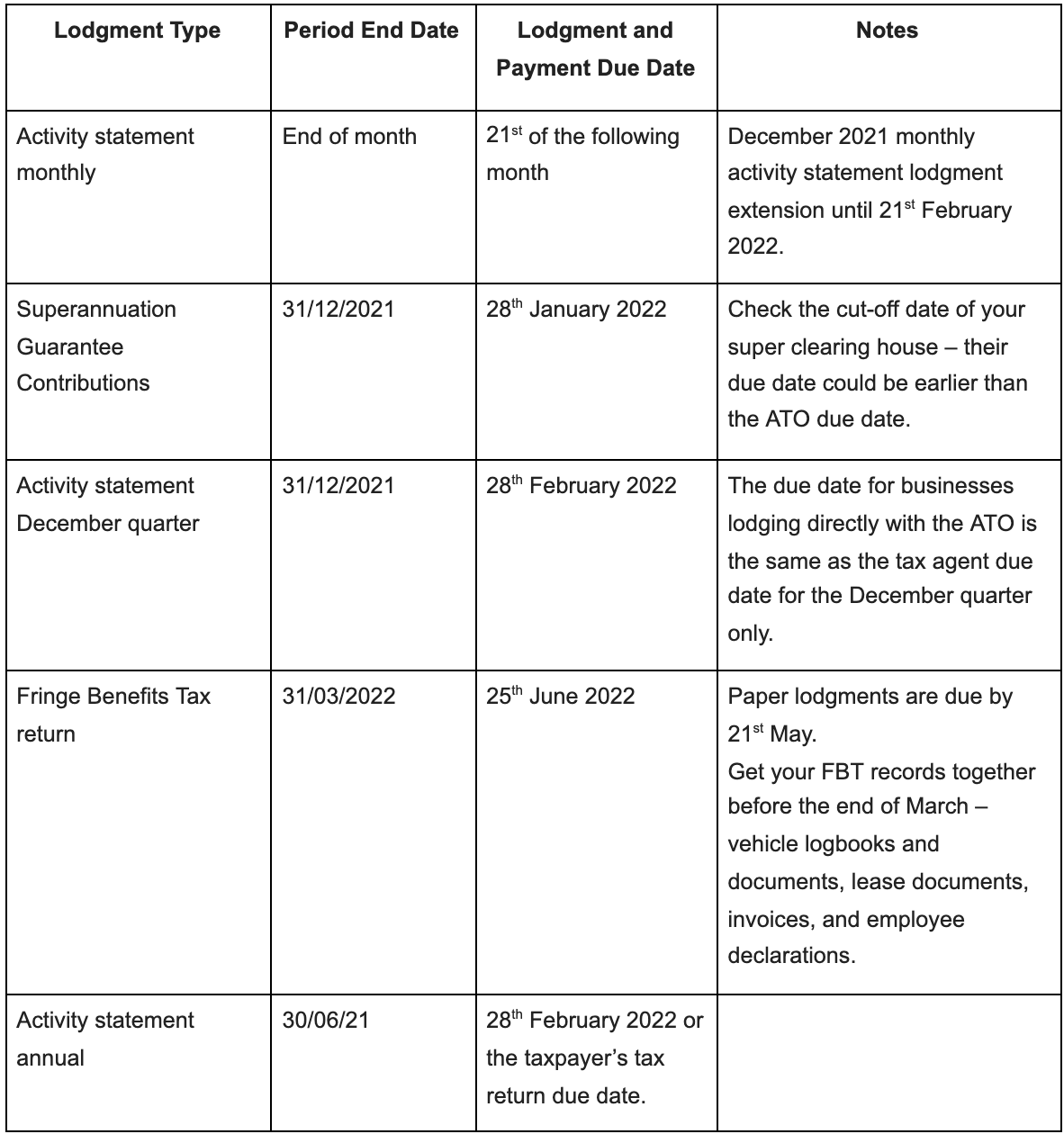
Lodgement and payment deadlines still apply, although you get a little extra time this quarter for your December obligations.

To help you get organised for the new year, we've highlighted some upcoming business lodgement due dates.

Q3 Deadlines table

Talk to Us About Lodgement Planning


If we're already lodging on your behalf, lodgement extensions automatically apply. You may have earlier deadlines if you're lodging activity statements and other forms directly with the ATO.

If you need more time to lodge and pay, let us know, and we can help you meet your obligations or arrange a lodgement extension if required.

Some tax return due dates fall within the first quarter of 2022. Talk to us if you're not sure of your business entity's tax return due date.

It's good practice to plan for your lodgement dates, so you're always ahead of the ATO and also for your cash flow planning. Don't get caught out with a penalty for late lodgement!

We are a registered BAS Agent. Get in touch to organise Busy 01 Consulting and First Class Accounts Ovens and Murray to manage your lodgements. 

Automating Bank Reconciliation

Automating bank reconciliation

Automating Bank Reconciliation

Good bookkeeping is all about recording and matching your financial transactions.

Over the course of a usual week of trading, you’ll have a range of payments being deposited into your bank account and a host of operational expenses being withdrawn from that same account.

To keep on top of this, you must match each line on your bank statement with the transactions recorded in your accounting software.

This process of matching the incoming (or outgoing) transaction with the relevant receipt, invoice or supplier bill is called bank reconciliation.

Why is bank reconciliation so labour intensive?

Bank reconciliation (or bank recs) is not the most thrilling part of the accounting process. But it’s essential if you’re going to have an accurate overview of your current accounting balance, and the balance that’s in your business bank account.

Traditionally, to complete the bank recs, you would need to:

  • Get a copy of your bank statement for the period
  • Check the deposits (cash coming in) and withdrawals (cash going out) on the statement
  • Look at the related credits and debits in your accounting software
  • Match these transactions to the relevant receipts, invoices or supplier bills
  • Reconcile your balance in the bank with the balance in your accounting software.

It’s a necessary process – and something you have to keep on top of. But it’s also a laborious and time-consuming task that eats into your admin time.

So, is there an alternative?

How can automation help to lighten the workload?

Accounting software has evolved in leaps and bounds over the past decade. And many of the innovations that are now available focus on alleviating the time-intensive tasks, like bank recs.

Modern cloud accounting packages offer a range of ways to not only lighten the financial workload, but also to improve speed, accuracy and efficiency.

For example:

Live bank feeds

These software integrations pull all the data from your online banking into the accounting software, giving you a live feed of your bank transactions.

Automated matching

Artificial intelligence (AI) and machine learning are used to automatically match the right invoices and bills with your bank transactions.

One-click matching

In a platform like Xero, you just need to review the automated matches and then click OK to match the transaction and complete the bank rec process.

Reduced human error

With an algorithm doing the matching, there are fewer errors in the bank rec process, and the whole process is completed in seconds, rather than hours.

Real-time bank and accounting balances

With live bank feeds and real-time data in your accounting software, you have the most current overview of your balances.

Talk to us about automating your bank reconciliation process.

If your current accounting platform doesn’t allow for automated bank recs, now’s the time to upgrade. Cutting out the manual processes gives you more time to focus on higher-value financial tasks, and keeps the reconciliation process ticking away silently in the background.

Get in touch to discuss switching to a new accounting platform.

ATO line of credit ending

ATO Line of credit ending


ATO Line of credit ending

As new reporting powers come into play, businesses are being warned against using the ATO as an alternative line of credit.

Debt Reporting Powers

In 2019, the ATO was afforded new debt reporting powers. While this took a backseat to the Covid-19 pandemic, the ATO is now cracking down on outstanding tax debt. 

Businesses without a payment plan, that are more than 90 days in arrears, and who owe more than $100,000 in tax are more likely to be reported to credit agencies by the ATO.

Impact on credit rating

In the past, business owners have sometimes used the ATO like a ‘line of credit’ by not paying their ATO commitments on time.

Taking this road is much more likely to have an adverse impact on your credit ratings and credit insurance limits. This, in turn, makes it more difficult to maintain or extend credit terms with suppliers.

Therefore, it's important to maintain a high level of communication with your creditors. 

Staying on the front foot

As business owners, if you owe tax, it's vital that you stay on the front foot with this ATO crackdown. We suggest you seek the advice of your BAS agent.

First Class Accounts Ovens and Murray, as your BAS Agent, are able to advocate on your behalf to deal with the ATO.

As Busy01 Consulting, we can also to assist with:

  • preparing a business plan
  • management advice
  • cash-flow planning and projection
  • systems development
  • business expansion
  • budget development
  • trading-structure planning.

Get in touch to discuss which options are best for your business. 

Single Touch Payroll Phase 2

Single Touch Payroll Phase 2 is Nearly Here


Single Touch Payroll Phase 2 Expansion is Nearly Here!

The expanded Single Touch Payroll (STP) Phase 2 is due to start on 1 January 2022.

However, the ATO has recently announced that there will be some flexibility with the reporting start date being allowed up to 1 March 2022 if the business is not ready by 1 January.

Businesses must now report all employees via STP. Plus, concessional reporting options are no longer available unless the employer has extraordinary circumstances.

It's important to note that employers should be reporting STP to the ATO on the day they pay employees.

What’s New with the Expanded Phase 2?

The STP Phase 2 report includes extra fields to allow for more detailed payroll information. The additional details enable the data to be reported to multiple government agencies using standard payroll categories.

This means the government agencies receive accurate data directly from the employer without extra forms or time-consuming administration.

STP Phase 2 Improvements

  • More income types and related special tax treatment.
  • Reporting gross pay in separate elements such as bonus, commission or overtime.
  • New employee tax file number declarations lodged directly with the ATO.
  • Employee termination information.
  • Clearer superannuation and lump sum payment reporting.
  • Easier for employees at tax time and when dealing with government agencies.
  • Better matching employer payroll data, employee tax return information, government agency payments and business activity statements.

The main payroll software providers are now bringing in phase 2 reporting categories, and in some cases, the changes have already happened in the background.

If you’re not already using an STP enabled payroll product, or you want to upgrade your software, talk to us about implementing a solution to make STP reporting quick and easy.

We can set you up with the right software or submit all the reports on your behalf.